
Interim licences expose fault lines in global FRAND litigation
12th IP and Competition Forum
Key takeaway: Courts are increasingly turning to interim licences to manage parallel litigation in standard-essential patent disputes, but practitioners remain divided on whether the remedy stabilises global FRAND enforcement or risks overreach into foreign jurisdictions.
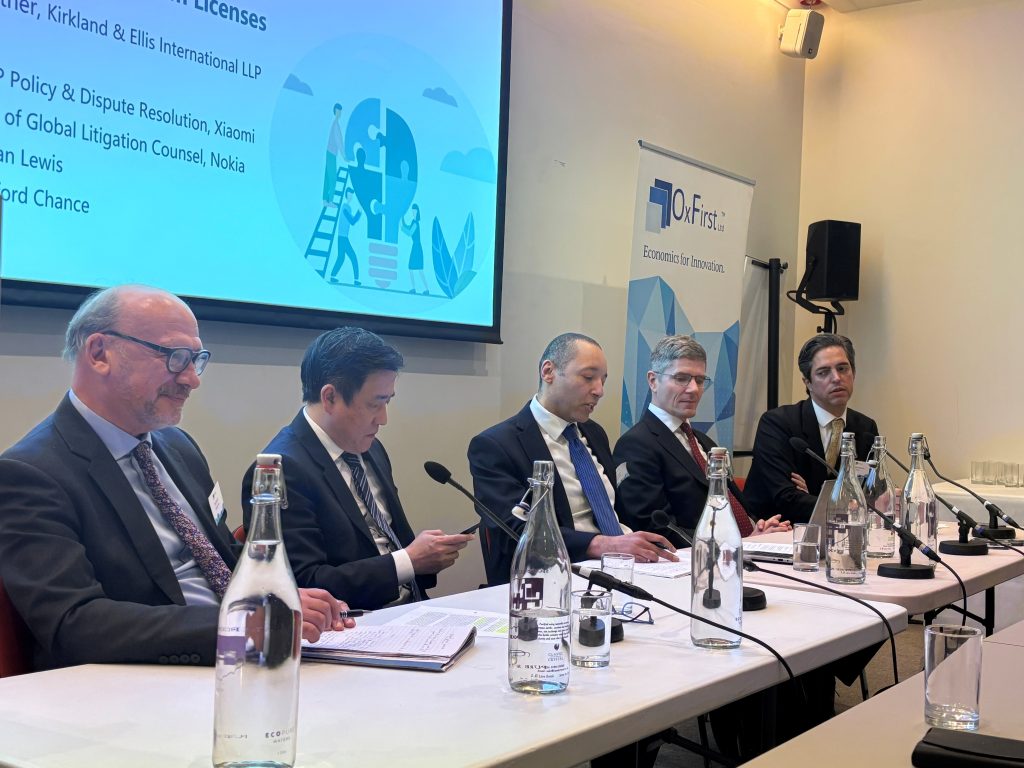
Speaking on a practitioner panel convened by OxFirst’s 12th IP and Competition Forum, external counsel and in-house lawyers said interim licence declarations have emerged in response to structural gaps in the global FRAND system, where patents are national, competition law is regional and licensing obligations are worldwide.
The origins of the English approach
Mr Rory Clarke, partner at Kirkland & Ellis, traced the English courts’ approach to Panasonic v Xiaomi, where parallel proceedings were under way in England, Germany and before the UPC. Xiaomi accepted the English court’s jurisdiction and sought expedition, while Panasonic reserved the right to enforce any foreign injunctions obtained before a FRAND determination.
The English Court of Appeal, by majority, granted the first interim licence declaration, reflecting what a willing licensee would do pending final rate-setting. A dissenting judge favoured an anti-suit injunction and raised concerns about Panasonic’s conduct. The dispute ultimately settled after the parties entered into an interim licence.
Mr Clarke said the approach remains under development, with some courts questioning whether the UK is encroaching on foreign jurisdiction by attempting to shape outcomes beyond its borders.
Mr Tim Powell, partner at Morgan Lewis, framed the issue in structural terms. SEPs, he said, “are property rights” but are constrained by both competition law and contractual FRAND commitments, creating a “territorial mismatch” that courts are struggling to resolve: patents are national, competition law operates regionally, and FRAND obligations are global. In the absence of any international agreement allocating jurisdiction over global FRAND disputes, courts are asserting authority that others may not recognise.
English courts do not treat interim licence declarations as injunctions, Mr Powell said. They “do not prohibit taking actions elsewhere” and are intended to be “persuasive” rather than coercive, protecting the integrity of domestic proceedings while leaving foreign courts free to decide how much weight to give them.
Nokia global litigation counsel Dr Heusch said the legal basis for interim licences remains contested. In Panasonic v Xiaomi, the declaration was granted in part because the SEP holder agreed to court-determined rate-setting. The deeper question, he said, is whether FRAND creates merely “a right to contract or an obligation on patentees to make a FRAND offer” — an issue on which English and some German courts diverge.
Dr Heusch also cautioned against overstating the practical power of injunctions, noting that implementers sometimes ignore them and that enforcement proceedings can be slow and commercially limited.
International differences of opinion
From a German constitutional perspective, Dr Tobias Hessel, partner at Clifford Chance, said the formal distinction between injunctions and declarations matters less than their practical effect. Any measure that deters a party from freely asserting its patent rights, or exposes it to adverse consequences for doing so, may impair access to justice under German constitutional law.
Jurisdiction, he said, should not be used to funnel disputes into a single preferred forum, and an injunction granted in one country has no legal effect in another.
Xiaomi senior legal director, Mr Chen, highlighted the commercial realities driving the debate. Germany remains the most important European market, he said, and injunctions affecting distribution channels there can trigger knock-on effects across other jurisdictions. Exposure to enforcement risk in Germany can shape strategic decisions with lasting market consequences.
Mr Chen said interim licences should remain a temporary solution while regulators or states work toward a more durable framework for FRAND disputes. Germany, he added, lacks a clear economic methodology for FRAND determination, a gap the UK courts have already started to fill.
Why interim licences are needed at all in the UK, where no domestic injunction risk arises before FRAND rates are set, was explained by the concern that parallel proceedings elsewhere can be used to pressure implementers into accepting supra-FRAND terms, undermining the English court’s process.
Where the panel landed
Closing the discussion, speakers agreed that no forum can identify a single “true” FRAND rate with scientific certainty. Suggestions for improvement included earlier hearings, interim case-management conferences — including before the Unified Patent Court — and greater use of court-moderated negotiation.
Despite deep disagreements, panellists said both patentees and implementers typically want resolution, and that carefully designed procedures may help guide them there — without turning interim measures into de facto global rate-setting by the back door.
Note: The views of the speakers do not necessarily reflect those of OxFirst, its affiliates, or employees. They also do not represent an official view the companies the speakers work for. They are only the personal views of the speaker.