
Munich judge defends Munich’s FRAND muscle as cases surge
12th IP and Competition Forum
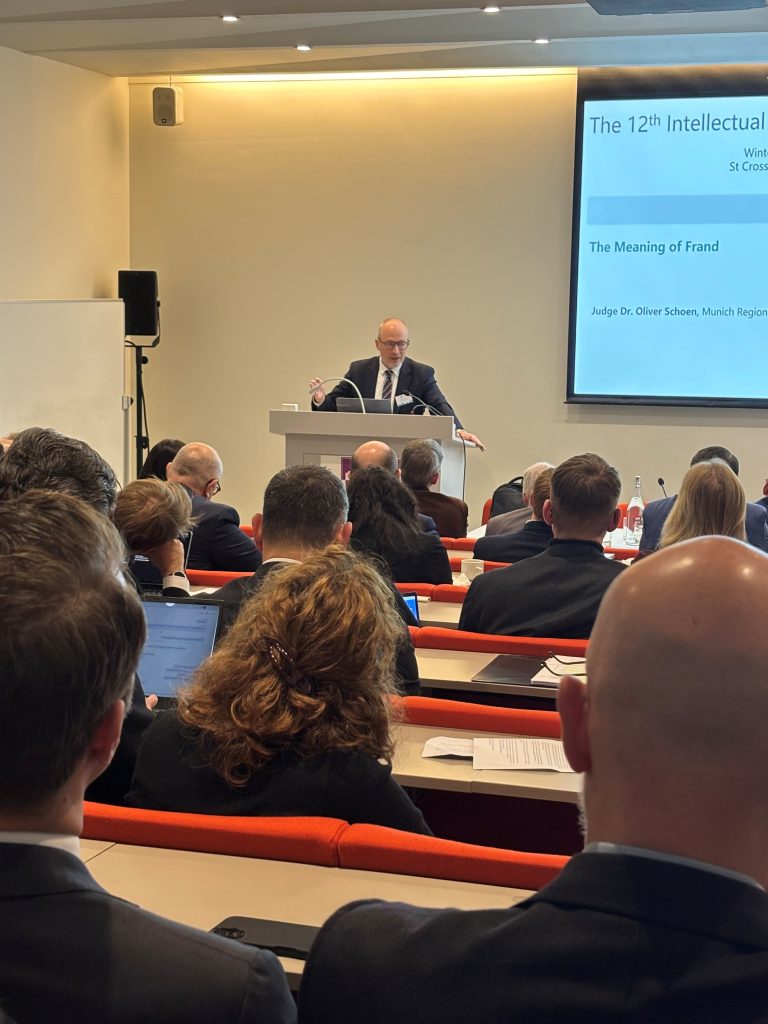
Key Takeaway: The Munich patent court courts remains one of the most powerful pressure points in global FRAND disputes, and they are showing no sign of retreat. In a keynote address at the OxFirst 12th IP and Competition Forum, held on January 13 & 14 in Oxford, Judge Dr Schoen of the Munich Regional Court offered a blunt, practice-driven account of how FRAND is applied in one of Germany’s busiest patent venue — and why Munich continues to matter.
The numbers set the tone.
Munich saw 317 new patent infringement cases last year, a 34 percent increase on the previous year. Despite the surge, cases still typically conclude in under a year. Efficiency, Judge Schoen said, is driven by procedural discipline: where the same patent is asserted in multiple actions, the court hears them together. But the workload is real, and the pressure on the court’s two patent chambers is growing.
At the core of FRAND disputes, Judge Schoen said, lies a simple economic reality. Innovation requires investment — time, money and expertise — and patents exist to protect that investment. In the telecommunications sector, where companies are large and portfolios global, disputes often crystallize around thin margins, infringement detail and valuation rather than first principles.
From an enforcement perspective, litigating everywhere is neither realistic nor necessary. In practice, only a handful of jurisdictions offer real leverage. Germany remains central, alongside the United States and, increasingly, the Unified Patent Court. The size of the German market means implementers cannot simply route around it, even where corporate structures are complex or deliberately opaque.
Judge Schoen rejected the suggestion that Germany applies FRAND in a way that inflates royalties. FRAND, he stressed, is anchored in Court of Justice of the European Union case law. There is no evidence that German courts systematically drive rates too high.
How far jurisdiction can stretch
Jurisdiction was a recurring theme. EU law, Judge Schoen explained, allows courts in certain circumstances to deal with infringement beyond their own territory. In a pharmaceutical decision handed down in December, the Munich court relied on the Brussels I Regulation to hear claims against multiple defendants, including parties domiciled outside Germany, where the claims were closely connected. This can extend to infringement in other Brussels I states. While the CJEU has insisted that the rule be interpreted narrowly, Judge Schoen said the result is unavoidable.
That jurisdictional reach feeds directly into FRAND enforcement. Judge Schoen discussed a recent FRAND rate determination case for which a written judgment has not yet been published. The clearest way to demonstrate FRAND compliance, he said, remains comparable licences — contracts showing actual payments and, in the case of lump sums, the unit volumes on which they are based.
In the absence of full comparables, courts must still decide. In this case, enough information was available to conclude that the patent holder’s offer was FRAND. The court applied a top‑down methodology, using standardised product prices rather than end‑user selling prices. Indicative values were assigned across product categories, from mobile phones to laptops.
The court then assessed the aggregate royalty burden, drawing on expert evidence from similar cases. That produced workable ranges — different for phones, tablets and laptops — allowing the court to identify both the lowest plausible implementer rate and the highest plausible patentee rate. Where evidence was missing, reasonable assumptions were made about product mix and portfolio shares. Currency conversions were applied consistently.
The result aligned with the rate offered to compliant licensees. On that basis, the court found the offer FRAND.
Willingness, money and injunctions
Judge Schoen closed with a warning about good faith. A willing licensee, he said, should be prepared to make an advance payment reflecting its counter‑offer. If regulatory or legal obstacles arise, they should be raised openly with the patent holder or the court. An outright refusal to pay can be used as evidence of unwillingness in his Court.
He also highlighted a fault line within the German system. The Higher Regional Court takes the view that FRAND should not be evaluated unless security has first been provided. His chamber disagrees. Where an implementer makes an advance payment, Judge Schoen said, the court should assess whether the patentee’s offer is FRAND.
The procedural consequence is stark. If the offer is FRAND, an injunction follows. If it is not, it does not. In Munich, FRAND is not an abstract policy debate — it is a gateway to exclusion from one of the world’s most important markets.
Note: The views of the speaker do not necessarily reflect those of OxFirst, its affiliates, or employees. They also do not represent an official view the companies the speakers work for. They are only the personal views of the speaker.